
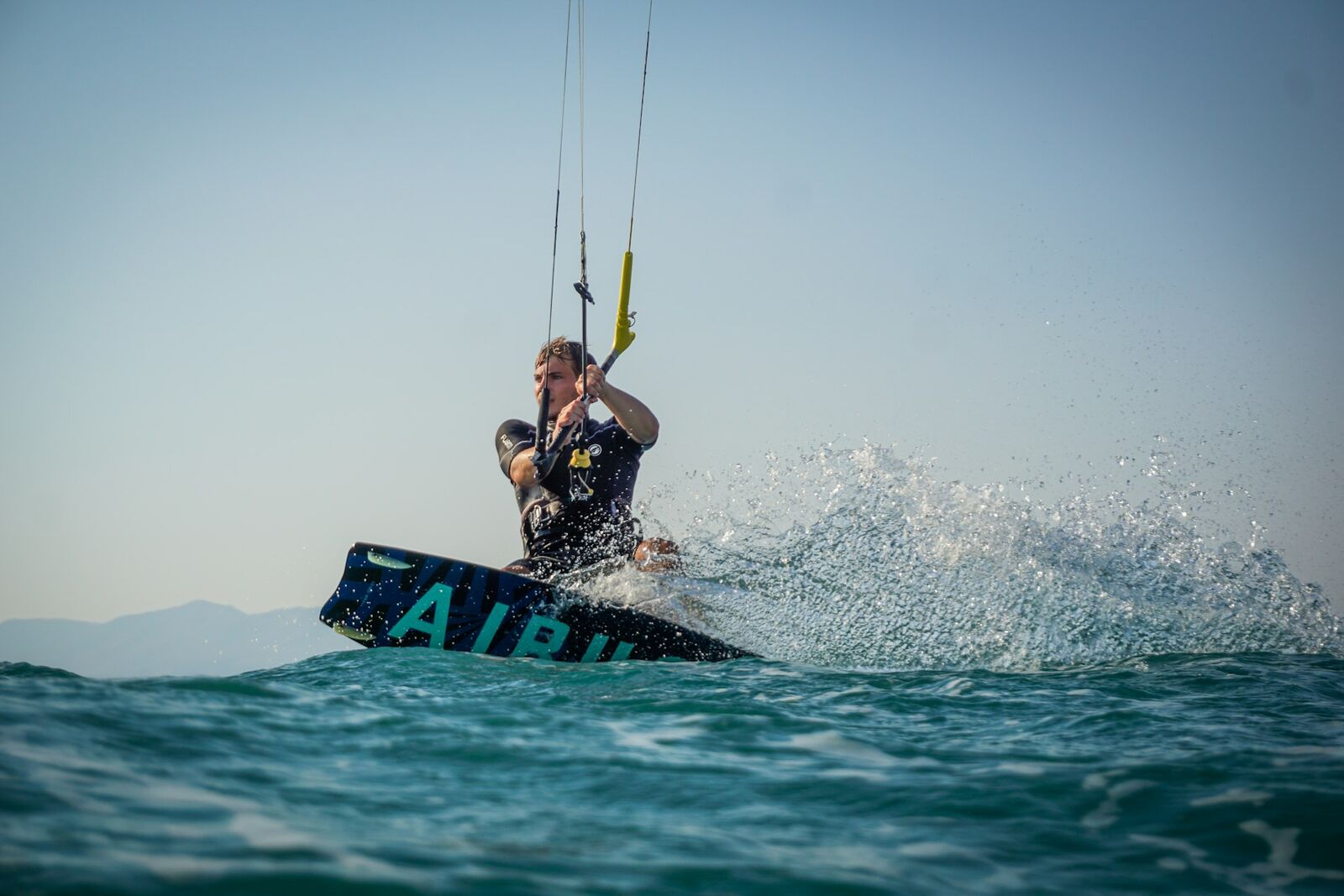
Ask a beginner what they're most excited to learn and almost nobody says "body dragging." They say riding, jumping, maybe just standing up on the board for more than three seconds. Body dragging is the stage in between the trainer kite and the board that gets skipped in every highlight reel, because on its own it just looks like someone getting towed through the water on their stomach. No board, no tricks, nothing to post. But ask any instructor which single skill predicts how fast a student progresses after that, and almost all of us will say the same thing: body dragging, and how seriously a student takes it.
What body dragging actually is
Once you can steer a full-size kite with some confidence — usually after a session or two on the trainer kite and the land briefing — we clip you into the harness, walk you into the shallow lagoon, and let the kite pull you through the water. No board. You're on your stomach or your back, steering with one hand on the bar, using your body as the only thing resisting the kite's pull. That resistance is the entire point. It's the first time you feel, in your whole body rather than just your hands, how much power is actually coming through the lines and how directly your steering translates into where you go.
We covered the basic shape of this stage in our walkthrough of a first lesson, but it's worth slowing down on why it matters, because "the unglamorous part before the fun part" undersells it badly.
It teaches you to read the kite, not just fly it
On the trainer kite, steering is mostly abstract — you move the bar, the kite moves, you watch it happen. Body dragging closes that loop through your whole body instead of just your eyes. You feel the power build as the kite sweeps toward the middle of the window and ease as it drifts to the edge, and you learn — quickly, because the water is an honest teacher — that oversteering yanks you off course and understeering leaves you drifting nowhere. That feel is the foundation everything after it is built on. A water start with a board bolted to that same feel goes fast. A water start without it turns into a fight against gear you don't yet understand.
Upwind dragging: the skill that saves you gear and energy
The first thing most students learn is downwind dragging, which is mostly about getting comfortable with the pull. The more useful skill comes next: dragging upwind, angling your body and the kite so you actually travel against the wind instead of just getting blown along with it. It's harder, it takes longer to click, and it's also the single most practical thing you'll learn before you ever stand on a board. Every rider eventually falls off downwind of where they wanted to be, or loses a board in a crash. Upwind body dragging is how you get back to it under your own power instead of swimming, waving for a boat, or losing the board to the shore break. Instructors who skip past this stage because a student is impatient to ride are setting that student up for a frustrating first few sessions with a board, and a genuinely difficult first solo outing after the lessons end.
It's the root of self-rescue, too
Every certified progression — ours included — treats body dragging as connected to the safety skills that come later: bringing the kite back under control after a fall, repositioning it, and eventually full self-rescue in open water. You won't get a self-rescue lesson on day one, but the body awareness and kite feel it depends on start forming the first time you're dragged across the lagoon with no board attached. Students who treat body dragging as a formality to get through tend to relearn these fundamentals the hard way later, usually at a worse moment than a calm lagoon with an instructor on the radio next to them.
What it actually feels like
Surprising, mostly. New students brace against the kite's pull the same way you'd brace against being pushed, and that's exactly backward — fighting it makes you sink and drag heavier through the water. The trick, which usually takes a handful of tries to land, is to lean back, keep your legs up near the surface like you're sledding rather than swimming, and let the harness take the load instead of your arms. Once that clicks, it stops feeling like effort and starts feeling like the first real speed of the whole lesson — which is usually the moment we hear the first genuine laugh of the day. It's also, for a lot of people, the first moment kitesurfing stops being an idea they're trying out and starts being something they're actually hooked on.
How long it takes, and when you're "done"
There's no fixed number of minutes — it depends on wind, water conditions, and how quickly a particular student's steering settles down, which is one reason we keep our lessons at a low instructor-to-student ratio rather than rushing a group through it on a schedule. Most students get comfortable with downwind dragging in a single session and spend real time on upwind dragging across their first two or three lessons — it's normal for it to take longer than the trainer-kite stage did. We've written more generally about how many lessons the full beginner progression tends to take, and body dragging is usually the stage where that timeline stops feeling fast and starts feeling like actual skill-building. That's not a bad sign. It's the stage doing its job.
The honest bottom line
Nobody signs up for kitesurfing lessons dreaming about body dragging, and we're not going to pretend it's the most exciting hour of a course. But it's the hour that makes every hour after it make sense — the kite feel, the upwind travel, the instinct to stay calm and get your gear back instead of panicking. Rush a student past it and you get someone who can awkwardly stay up on a board in perfect conditions. Let it sink in properly and you get someone who can actually kitesurf, in a range of conditions, without a leash on their nerves. If you want to see where it fits in the fuller progression, our FAQ covers common questions about lesson pacing, and you can read more about the instructor team who'll be on the radio with you through all of it. Either way, when you're ready to feel it for yourself, we're on the beach most days.
Ready to get on the water?
IKO-certified instructors, radio helmets, and steady Cabarete trade winds. First hour free with code SENDIT.
Book a Lesson